


How to Care for a Miami Dolphins Jersey
The care routine for a stitched jersey takes about ninety seconds of extra attention and reliably adds years of wear. The expensive mistakes all involve a dryer, an iron, or a washing machine loaded with hardware.
Quick Answer
Wash inside out in cold water on a gentle cycle, never use bleach or fabric softener, and hang dry. Avoid ironing directly over numbers, and store folded with nothing heavy on top. That routine covers every common failure mode.
Key Takeaways
- ▸Classic home colourways stay relevant across roster changes.
- ▸Measure your chest rather than trusting a t-shirt size.
- ▸Two jerseys in rotation last longer than one bought twice.
- ▸Wash cold and hang dry to protect stitched numbers.
Quick Facts
- Every team stays in stock across game, replica, legacy, alternate and throwback cuts.
- Availability changes by size, not by team — check the specific size on the product page.
- Big-and-tall lines carry fewer sizes and sell through first once a popular player is in.
- A team-level design outlives a player-specific one through every rebuild.
How Should You Wash a Stitched Jersey?
| Rule | Why it matters | |
|---|---|---|
| Do | Turn the jersey inside out before washing | Protects stitched twill and printed numbers from abrasion |
| Do | Machine wash cold on a gentle cycle | Hot water shrinks polyester and dulls dye |
| Do | Hang dry or lay flat | Heat is the single biggest cause of cracking and shrinkage |
| Do | Wash separately from zippers and velcro | Metal teeth snag mesh fabric in the drum |
| Don't | Iron directly over numbers or a nameplate | Direct heat melts the bond layer under stitched twill |
| Don't | Use bleach or fabric softener | Both break down the fibres that keep the jersey from pilling |
| Don't | Dry clean a stitched jersey | Solvent cycles stress stitched seams more than a cold wash |
| Don't | Store folded under heavy items | Long-term compression leaves creases that never fully lift |
Which One Should You Pick?
| If this is you | Pick this | Why |
|---|---|---|
| You follow one team and nothing else | Team-level home jersey | Works regardless of which round that team reaches |
| You follow a player, and you know the number | Throwback or legacy cut | Tied to an era, so it stays relevant after a trade |
| You are buying for someone else | Game cut, home colourway | Deepest size range, easiest to exchange |
| You already own their current jersey | Alternate cut, same team | More variety from a team you already support |
| You are hard to fit for | Big and tall, order first | Thinnest line; ordering later means fewer choices |
Turn the jersey inside out first, every time. That single step moves the numbers and the nameplate away from the drum wall, so the surface that takes the abrasion is the plain back panel rather than the decoration you actually care about.
Use cold water on the gentlest cycle your machine offers, with a small amount of normal detergent. Cold water lifts everyday soil perfectly well and avoids the two things heat does to polyester: it accelerates shrinkage and it softens the bond layer under any printed or heat-sealed numbers.
Skip bleach and skip fabric softener. Bleach attacks the dye that makes a team colourway readable, and softener leaves a coating on the fibres that traps odour instead of releasing it in the wash. Both effects are cumulative and neither is reversible.
A second jersey in a different colourway extends the useful life of the first. Rotating two jerseys halves the wash cycles each one sees, and it gives you an option for warm-weather games when the heavier fabric stays in the closet anyway.
Stitched numbers and letters are built from layers of twill that are sewn through the fabric rather than bonded to the surface. That construction costs more and adds weight, which is why a stitched jersey feels denser in the hand and holds its shape across a long season instead of softening at the shoulders after a few washes.
What Shortens a Jersey's Life the Fastest?

The dryer is the biggest single culprit. Tumble heat shrinks polyester slowly and seals in creases along seams, and it is the reason a jersey that fitted well in October feels tighter by January without anyone losing or gaining weight.
The second is washing with hard trim. Zippers, velcro, snaps and even heavy denim act like abrasive pads against mesh, and the pulls they create appear across the back panel where they cannot be hidden. Washing jerseys together, or alone, removes the problem completely.
The third is the iron. Direct heat over a number melts the layer holding printed decoration to the fabric, and it flattens the loft in stitched twill so the number reads permanently dull. If you must press a jersey, do it inside out on the lowest setting and never over the decoration.
Wash jerseys away from zippers, velcro and anything with hard trim. Metal teeth and hook-and-loop fasteners act like sandpaper against mesh in the drum, and the resulting pulls appear on the back panel where they are hardest to hide.
Storage matters as much as the jersey itself. Fold along the shoulders rather than creasing the numbers, keep it out of direct sunlight, and avoid vacuum bags that compress stitched twill into permanent ridges. A breathable garment bag does the job without adding pressure.
Fan gear is social equipment. A jersey gives strangers an opening line in a parking lot, which is why the most-worn jerseys in any stadium are the ones carrying the most recognisable colours rather than the most expensive construction.
Jerseys are cut wider through the chest and longer in the body than a standard t-shirt of the same labelled size. If you normally wear a medium t-shirt, a medium jersey will fit, but with noticeably more room under the arms, which is exactly the space you want for layering.
Every fan base develops its own way of wearing a jersey. Some treat it as a shirt, some as a jacket substitute, and some as a display piece. The Miami Dolphins range covers all three habits, which is why the same store can serve a tailgate crowd and a collector without splitting into separate products.
Turn the jersey inside out, wash cold on a gentle cycle, and hang it to dry. That single routine prevents nearly every failure mode people attribute to poor quality: cracked numbers, dull dye, puckered stitching and slow shrinkage that only shows up after a dozen washes.


How to Store Jerseys in the Offseason
Fold along the shoulder line rather than creasing through the numbers. A crease pressed into stitched twill for six months does not lift fully when you unfold it, and the ridge shows most clearly in the exact place a photograph draws the eye.
Use a breathable garment bag or a clean cotton pillowcase instead of vacuum storage. Compression bags save space but flatten the twill and stress the seams, and a jersey that has spent the summer under vacuum never hangs quite the way it did before.
Keep stored jerseys out of direct sunlight. Long exposure fades dye unevenly, and the fade shows first along the shoulder where the sun hits at an angle, which produces a two-tone effect that looks like a manufacturing fault but is really a storage decision.
The shoulder seam is the truest fit signal. It should land at the outer edge of your shoulder, not slide down the arm. If the seam is already past your shoulder in a mirror, sizing down usually gives a cleaner line even if the chest measurement looks correct on paper.
The Miami Dolphins colourway palette is deliberately narrow, and that is a feature rather than a limitation. Because the palette is stable, one jersey works across a decade of photos, which is exactly what people want from a piece they plan to keep rather than replace.
The quickest way to judge construction without a spec sheet is to look at the inside of the jersey. A stitched number leaves a second layer of thread behind the fabric, while a printed number leaves only a faint outline. Look behind the shoulder seam and the evidence is usually obvious within seconds.
Collectors tend to care less about the current depth chart and more about construction details that survive a decade of storage: reinforced shoulder seams, layered twill, and a nameplate sewn rather than pressed. Those are the things that still look right when the jersey comes out of the closet years later.
Layering changes the maths. A jersey worn over a hoodie needs roughly one size of extra room through the chest to avoid pulling at the seams, and that same extra size will look loose when worn alone over a t-shirt. Decide which way you wear it most before choosing.
Fixing Common Problems Before They Become Permanent
For wrinkles, hang the jersey in a steamy bathroom rather than reaching for an iron. Ten minutes of ambient steam relaxes polyester without any contact, and it is safe for stitched and printed decoration alike.
For light odour, air the jersey overnight before washing it again. Polyester holds odour in the fibre, and a night on a hanger releases most of what a second wash would only partly remove, which saves wear on the decoration over a full season.
For small pulls, resist the urge to cut the loose thread. Pull the loop through to the inside and knot it gently against the reverse of the fabric. Trimming on the outside leaves a hole that widens with every subsequent wash.
Most jerseys sold for fan wear use a polyester mesh chosen for breathability rather than brute durability. The weave lets air move through the chest panel, which matters far more than thickness once you are sitting in direct sun for three hours with no shade and a crowd pressed in around you.
The honest way to price a jersey is cost per wear. A heavier stitched jersey worn twice a month across a full season works out cheaper than replacing a light printed jersey every year, because the failure points are the seams and the numbers, and both last longer when they are sewn rather than bonded.
Polyester takes dye deeply, which is why team colourways stay saturated across seasons. The trade-off is that the same fibre holds odour, so a jersey benefits from being aired out overnight rather than thrown straight into a laundry basket after every wear.
Heat is the enemy, not water. A cold wash lifts everyday soil without stressing the fabric, while a hot dryer cycle softens the bond layer under printed numbers and pulls polyester out of shape. Air drying costs an extra hour and buys years of wear.
Mesh weight is the quiet variable nobody advertises. A lighter mesh layers easily under a jacket and dries fast after rain, while a heavier mesh resists creasing and photographs better when hung. Neither is better in the abstract; the right answer depends entirely on how you plan to wear it.
Buying the classic home colourway first is the most reliable decision in fan apparel. It stays current across roster changes and coaching turnover, so the money you spend does not date the moment a depth chart shifts in the spring.
Featured Stitched Jerseys
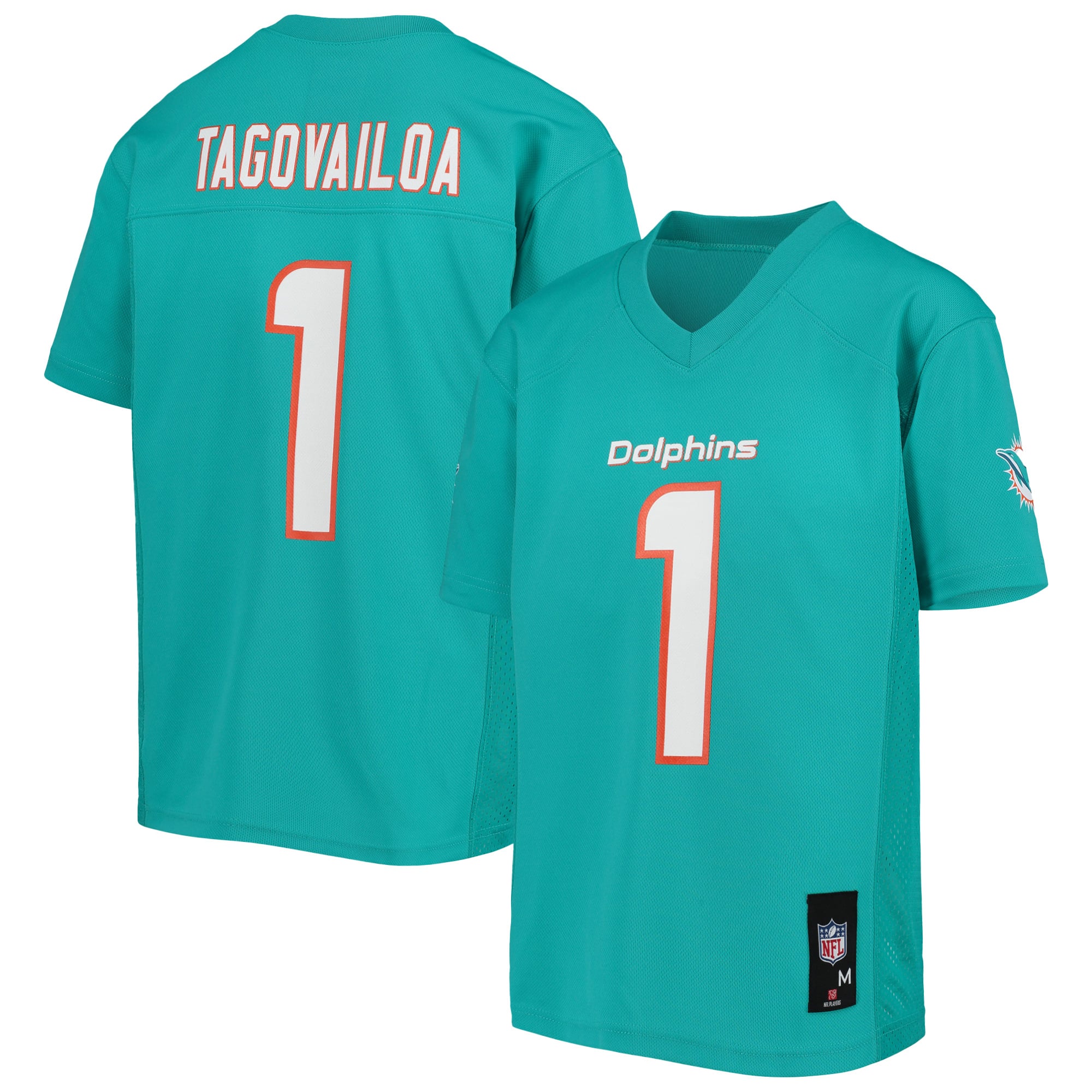


Frequently Asked Questions
Can you put a stitched jersey in the dryer?
How do you remove wrinkles from jersey numbers?
How long should a jersey last with regular wear?
Should jerseys be washed after every wear?
How do you store a jersey long term?
Keep Reading
- NFL Jersey Buying Guide: Sizing, Care, Tiers and Team Guides
- Chicago Bears Jersey Sizing Guide: Fit Charts, Measurements &…
- Miami Dolphins Jerseys
- AFC East Hub
- Shop All Jerseys
Common Mistakes Worth Avoiding
- Buying the current cut for a specific era look
Period cuts differ in shoulder, number weight and collar. Colour alone will not do it. - Assuming a throwback will fit like the jersey you own now
It is cut differently rather than sized differently. Check the product page. - Sizing down because a structured cut feels tight
Sizing up is the more recoverable mistake, especially if you layer over it. - Buying a name before the team is settled
Player-specific designs lose relevance the moment that player moves.
Build Your Rotation
Classic colourways, stitched construction, sizes for the whole family.
Browse NFL JerseysReviewed by Pro Football Jersey Vault · Last updated September 22, 2026
