


Los Angeles Chargers Throwback, Color Rush and Alternate Jerseys
Jersey design is a record of how the sport has changed, and the throwback styles on sale today are not nostalgia for its own sake. Each one marks a specific era in how the game was presented and how fans watched it.
Quick Answer
Throwback looks revive a historical design in a modern cut, alternate colorways use a secondary team color, and color rush styles are bold monochrome looks built for night games. All three exist to give fans an option beyond the standard home uniform.
Key Takeaways
- ▸Two jerseys in rotation last longer than one bought twice.
- ▸Wash cold and hang dry to protect stitched numbers.
- ▸Construction matters more than price when you are choosing a jersey.
- ▸Classic home colorways stay relevant across roster changes.
Quick Facts
- Every team stays in stock across game, replica, legacy, alternate and throwback cuts.
- Availability changes by size, not by team — check the specific size on the product page.
- Big-and-tall lines carry fewer sizes and sell through first once a popular player is in.
- A team-level design outlives a player-specific one through every rebuild.
Los Angeles Chargers Throwback Styles: What Changed and What Held
The practical difference between a throwback and a current design is usually not radical. It is a shoulder cut, a font weight, a stripe width, a number placement, or a collar shape. Small changes, combined, are enough to read as a different era. This is also why a throwback is not simply a current jersey in different colors — the colorway is the least interesting part of the reference.
The safest way to buy a throwback is to know which feature you are actually drawn to. If it is the weight of the fabric, look at the material first. If it is the shape, look at the shoulder and sleeve. If it is the number and name font, check the close-up images. Buyers who decide on the feature they care about are far less likely to end up disappointed by the features they never considered.
The most common mistake is assuming the throwback will be versatile. An era-accurate cut is by definition not the cut most people wear every day, so it tends to be an occasional piece rather than a rotation staple. Buyers who want something they can wear weekly are usually better served by a current-style home jersey, and buyers who want a distinctive piece are usually better served by the throwback they started with.
Demand for a retro look is usually a demand for a specific feeling rather than a specific year. Fans tend to describe the era they want by its texture: heavy, boxy, tucked in, high socks, or sleeveless. If you can identify the feeling, you can often find a design that delivers it without needing to be exact about the season, which widens the range of options considerably.
| Colorway | What it is | Why fans pick it |
|---|---|---|
| Home | The primary team color fans see most weeks | Safest pick if you do not know a size or a preference |
| Away | Usually white or a light neutral base | Reads cleanest in photos and warm-weather wear |
| Alternate | A secondary color used a few times a season | Stands out in a crowd of home jerseys |
| Throwback | A historical look revived for a modern cut | Favorite of long-time fans and collectors |
| Color Rush | A bold monochrome look built for night games | The most visually distinctive option on the rack |
Which One Should You Pick?
| If this is you | Pick this | Why |
|---|---|---|
| You follow one team and nothing else | Team-level home jersey | Works regardless of which round that team reaches |
| You follow a player, and you know the number | Throwback or legacy cut | Tied to an era, so it stays relevant after a trade |
| You are buying for someone else | Game cut, home colourway | Deepest size range, easiest to exchange |
| You already own their current jersey | Alternate cut, same team | More variety from a team you already support |
| You are hard to fit for | Big and tall, order first | Thinnest line; ordering later means fewer choices |
The modern cut is what makes it wearable. A true vintage jersey would sit entirely differently on the body, so today's throwbacks pair the historical colorway and lettering with current fabric and sizing, keeping the look while fixing the fit.
Fan gear is social equipment. A jersey gives strangers an opening line in a parking lot, which is why the most-worn jerseys in any stadium are the ones carrying the most recognisable colors rather than the most expensive construction.
The shoulder seam is the truest fit signal. It should land at the outer edge of your shoulder, not slide down the arm. If the seam is already past your shoulder in a mirror, sizing down usually gives a cleaner line even if the chest measurement looks correct on paper.
Reading Color Rush and Alternate Los Angeles Chargers Looks

Special looks and alternates are not the same thing, and the distinction matters when you are buying. A special uniform is produced for one event and is often not repeatable year to year. An alternate is a standing part of the rotation and is much more likely to be worn again. If you want a jersey you will still be able to pair with a hat or a hoodie in three years, an alternate is the safer choice than a one-off special.
Fans collect alternates for the same reason they collect anything: the rare one is the fun one. Availability is uneven across sizes and seasons, and the versions that were only worn for a handful of games are the ones that become hard to find. If you are buying an alternate as the main event of a purchase, checking size availability first will save a lot of disappointment later.
The practical takeaway is that alternates are the easiest way to own two jerseys of the same team without owning two copies of the same shirt. One home and one alternate reads as a deliberate pair, fills a rotation that a single jersey cannot, and gives the buyer a reason to pick a design on taste rather than on availability.
Design-wise, a good alternate does one of two things. Either it stays inside the core palette and changes only the emphasis, which is why the most successful alternates look familiar, or it introduces a genuinely new dominant color and accepts that it will feel like a different uniform. The first is easier to wear and repeats better. The second is more memorable and reads as an event.
Alternates are subtler. They use a secondary team color that appears only a few times a season, which gives fans an option that still belongs to their team but is far less common in the stands than the standard home look.
Layering changes the maths. A jersey worn over a hoodie needs roughly one size of extra room through the chest to avoid pulling at the seams, and that same extra size will look loose when worn alone over a t-shirt. Decide which way you wear it most before choosing.
Buying the classic home colorway first is the most reliable decision in fan apparel. It stays current across roster changes and coaching turnover, so the money you spend does not date the moment a depth chart shifts in the spring.
Team colorways carry decades of association that has nothing to do with any single season. That is why a Los Angeles Chargers jersey still sells through roster turnover and coaching changes: the colors and the crest are the constant, and fans buy continuity as much as they buy a garment.
Most jerseys sold for fan wear use a polyester mesh chosen for breathability rather than brute durability. The weave lets air move through the chest panel, which matters far more than thickness once you are sitting in direct sun for three hours with no shade and a crowd pressed in around you.


The Los Angeles Chargers Demand for Retired-Number Jerseys
Scarcity here is not manufactured. The number cannot be reissued to a different player, so the set of possible designs is genuinely closed. That is a fundamentally different economics from a general merchandise item, and it is why a retired-number jersey can hold appeal for a buyer who will never watch that player live and does not follow the team currently.
A number retirement also creates a natural division between what the current team does with that number going forward. Some teams keep the honor visible, others retire it quietly, and the treatment tells you whether the current organization wants the former player presented as a legacy figure or simply as part of the past. If the current context matters to you, it is worth knowing before you buy.
There is also a secondary audience that is easy to overlook: the fan of a team the buyer does not follow at all. A distinctive, well-known retired number is legible without context in a way that a current roster name is not. That makes a retired-number jersey a surprisingly good gift for a general football fan, because it reads as an established piece of the sport rather than a commitment to a particular season.
The most common buyer is someone whose attachment is to the era rather than the current roster. They watched the games, they bought a jersey at the time, and they still think about that team. For that person the jersey is a souvenir of something real, and a design that reproduces the era accurately is worth more than a cheaper design that does not.
They also solve a gift problem. Buying a current player's jersey is a bet on a career, while a retired number is a settled fact. Givers who want a piece that will still feel right in five years naturally gravitate towards them.
Mesh weight is the quiet variable nobody advertises. A lighter mesh layers easily under a jacket and dries fast after rain, while a heavier mesh resists creasing and photographs better when hung. Neither is better in the abstract; the right answer depends entirely on how you plan to wear it.
Turn the jersey inside out, wash cold on a gentle cycle, and hang it to dry. That single routine prevents nearly every failure mode people attribute to poor quality: cracked numbers, dull dye, puckered stitching and slow shrinkage that only shows up after a dozen washes.
Displaying a jersey is a design decision. A simple hanger on a wall is fine, but a frame with a neutral background keeps the focus on the crest and the number. Avoid taping or pinning through fabric; the pin holes never close and they show up immediately under gallery lighting.
Stitching changes how a jersey drapes. The extra layer keeps the chest panel from collapsing, so the cut reads straighter on the body. For anyone who wears a jersey over a hoodie, that structure prevents the fabric from bunching under the arms during a long afternoon in the stands.
Wash jerseys away from zippers, velcro and anything with hard trim. Metal teeth and hook-and-loop fasteners act like sandpaper against mesh in the drum, and the resulting pulls appear on the back panel where they are hardest to hide.
Featured Stitched Jerseys

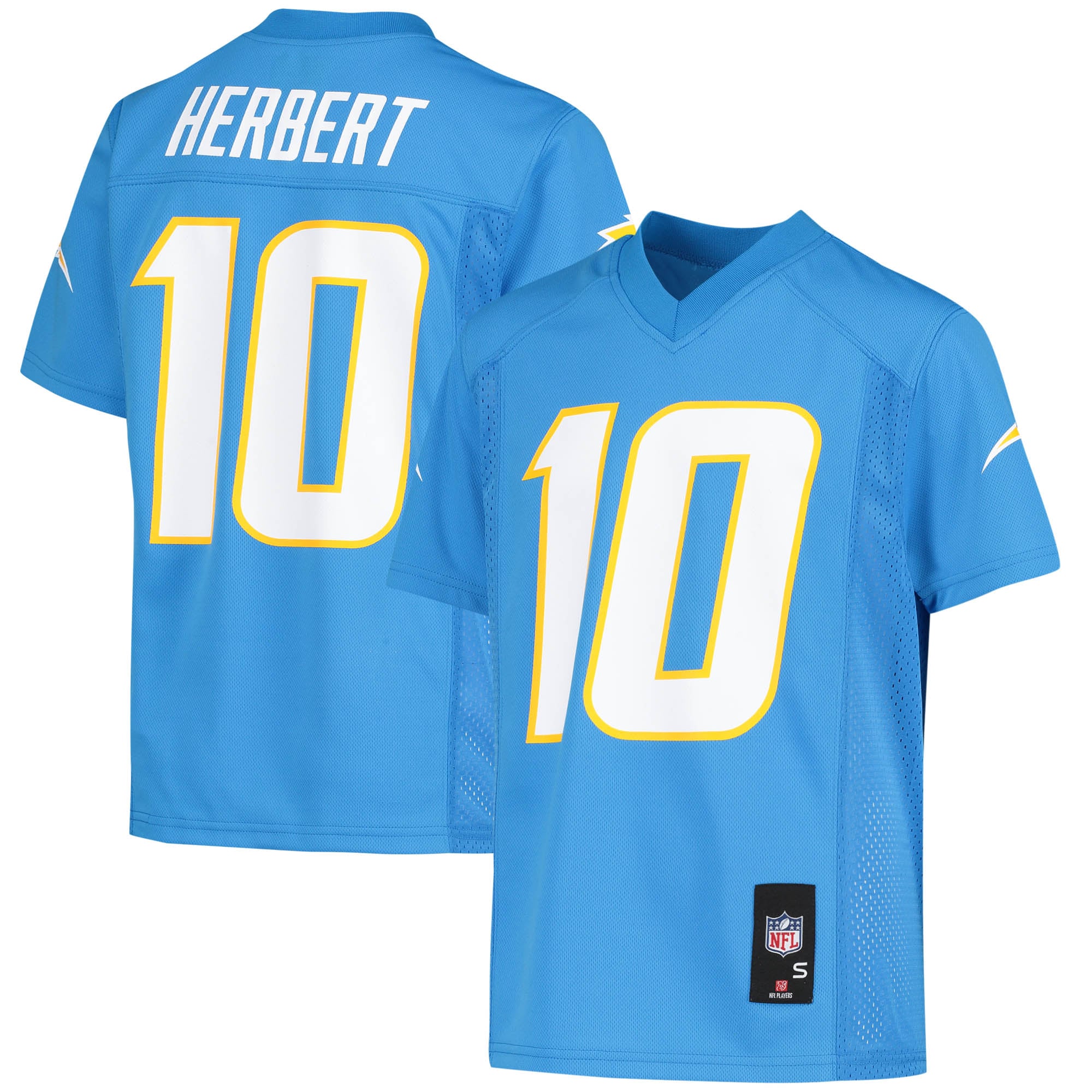


Frequently Asked Questions
Why do throwback jerseys look so different from current ones?
What is a color rush jersey?
Are retired player jerseys still made?
Should an alternate colorway be a first jersey?
Do historical designs come back in different colors?
Keep Reading
- NFL Jersey Buying Guide: Sizing, Care, Tiers and Team Guides
- Chicago Bears Jersey Sizing Guide: Fit Charts, Measurements &…
- Los Angeles Chargers Jerseys
- AFC West Hub
- Shop All Jerseys
Common Mistakes Worth Avoiding
- Buying the current cut for a specific era look
Period cuts differ in shoulder, number weight and collar. Colour alone will not do it. - Assuming a throwback will fit like the jersey you own now
It is cut differently rather than sized differently. Check the product page. - Sizing down because a structured cut feels tight
Sizing up is the more recoverable mistake, especially if you layer over it. - Buying a name before the team is settled
Player-specific designs lose relevance the moment that player moves.
Build Your Rotation
Classic colorways, stitched construction, sizes for the whole family.
Browse NFL JerseysReviewed by Pro Football Jersey Vault · Last updated October 06, 2026
